
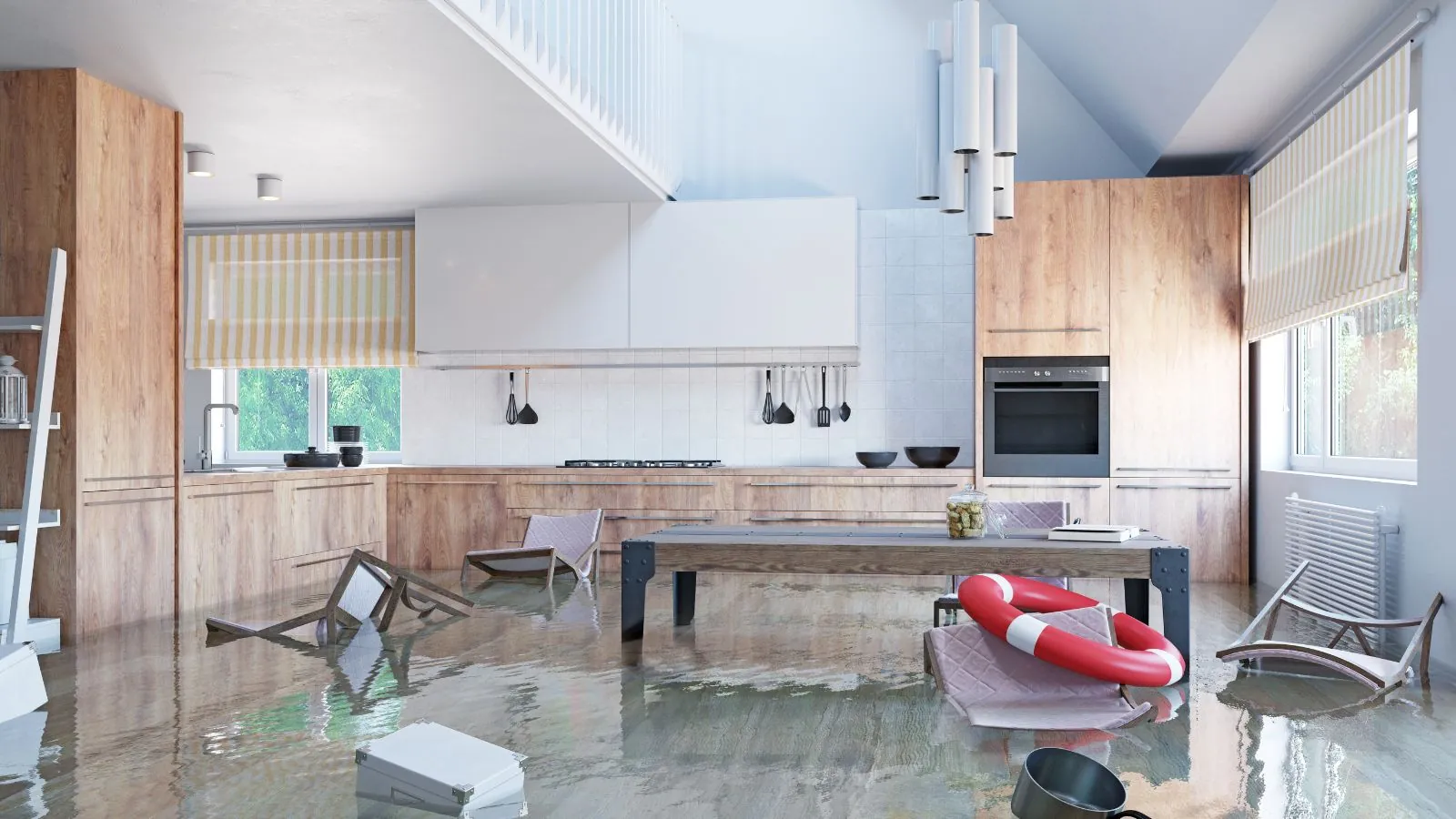
Kitchen water damage is moisture in the cabinets, flooring, walls and subfloor around the sink, dishwasher, refrigerator and counters. It is mostly a materials problem, because particleboard cabinet bases swell when wet and stay swollen even after they feel dry on the surface.
If you see water now, shut off the valve under the sink or the main, empty the cabinet and run the call through our 24/7 dispatch line. A wet cabinet floor can look minor and still be holding water in the layers underneath.
Where kitchen water actually hides
Water in a kitchen rarely stays on the counter or the cabinet floor. It runs to the lowest seam and then under the toe kick, behind the dishwasher and into the subfloor. That is why a dry-looking cabinet can still read wet on a meter.
| Source | Where the water hides | What we check |
|---|---|---|
| Sink supply or drain | Cabinet floor, back wall and the floor under the cabinet | Cabinet base, plumbing wall and flooring seams |
| Dishwasher line | Toe kick, side panels and subfloor below the machine | Adjoining cabinets and the floor edge |
| Refrigerator ice line | Behind and under the unit, often unseen for weeks | Flooring, wall base and the subfloor |
| Counter and backsplash gaps | Behind laminate and into the cabinet top | Counter edge, particleboard and wall |
Why under-sink leaks do slow damage and fast swelling
A drip from a trap or a supply connector may only release a cup of water a day. That is enough to soak particleboard from the inside, and swollen particleboard does not shrink back.
The damage often shows as a warped cabinet floor, a soft toe kick or flooring that lifts at the sink edge. A moisture meter finds how far the wet area extends before anything is cut or removed.
Call any hour. We check the base, the toe kick and the wall behind before anything is replaced.
Dishwasher and refrigerator leaks, and where this page stops
When an appliance itself has failed, the cleanup page for that situation is appliance leak water damage. This page covers what the water did to the cabinets, counters and floor around it.
The two jobs often come together. A failed hose is fixed by a plumber or appliance technician, and the wet cabinet bases and flooring are dried and restored by us.
Save the cabinet or replace it
The answer depends on the material and how long it stayed wet.
| Material | Usually saved when | Usually replaced when |
|---|---|---|
| Solid wood face frame | Dried quickly and not warped | Rot, delamination or lasting stain |
| Plywood box | Wet briefly and drying readings normal | Layers separating or swollen edges |
| Particleboard base | Rarely, only after a very short wetting | Swollen, crumbling or sagging under weight |
| Laminate counter edge | Dry and flat | Lifted or bubbled at the seam |
First steps at the sink
Do this before the crew arrives
- Close the shutoff valve under the sink, or the main water valve if the valve is stuck.
- Empty the cabinet and set wet items on a dry surface to photograph them.
- Pull the toe kick cover if it comes off easily, and leave the rest to the crew.
- Do not run the dishwasher or the disposal until the source is fixed.
- Photograph the cabinet floor, the walls and the flooring before anything is moved.
Flooring and walls around the cabinets
Water that leaves the cabinet usually reaches the flooring next. Tile survives, but the grout and the subfloor under it can stay wet. Vinyl and laminate trap water at the seams, and the floor can lift weeks later.
Behind the cabinets, the wall base soaks up water through the bottom edge of the drywall. We check that wall with a meter and open a small section only if the readings call for it.
What affects the cost of kitchen water damage
Kitchen jobs combine drying and repair, so scope matters. We explain scope and price before work starts.
| Factor | How it changes the job |
|---|---|
| Cabinet material | Particleboard often has to be replaced, while solid wood can often be dried |
| Flooring type | Tile, vinyl, laminate and hardwood each react to water differently |
| How long the leak ran | A slow leak soaks deeper and wider than a short burst |
| Area behind appliances | Moving the dishwasher or refrigerator adds access work |
| Repair scope | Drying is one cost, and new cabinets and counters are another |
Insurance often responds to sudden and accidental kitchen leaks, and slow seepage left unrepaired is often treated differently. Flood damage usually needs separate flood coverage. Check your policy or ask your insurer, and ask what documentation they want. We record moisture readings and photos so you have them ready.
When the repair involves plumbing or electrical work
Replacing supply lines, relocating a sink or rewiring a counter circuit can involve permits. Permit rules vary, so ask the Town of Hempstead Building Department, which enforces plumbing and electrical codes for homes in Bellmore, ZIP 11710.
If the water also reached the ceiling below, ceiling repair may be the next step. If the floor is hardwood, the hardwood floor page explains when boards can be saved. Our line also serves nearby Freeport kitchens.
Kitchen water loss: safety checks before work begins
Do this first
- Turn off power to the kitchen circuits at the panel only if the panel and floor around it are dry
- Unplug the refrigerator, dishwasher and small appliances only if you can reach the outlet without standing in water
- Shut off the supply valve under the sink or at the appliance
- Keep children and pets out of the kitchen until the floor is dry and any broken glass is cleared
- Photograph the cabinet bases, floor and source before anything is moved
The standard behind the work
Restoration professionals point to ANSI/IICRC S500 as the published standard for water damage work, and you can ask any company whether its crews follow it.
Frequently asked questions
Look for swelling, a soft or warped cabinet floor, a musty smell and peeling edges. A moisture meter gives a real answer, because wet particleboard can feel dry on the surface.
Sometimes. Solid wood and plywood often dry and stay sound, while swollen particleboard usually has to be replaced because it does not shrink back.
When needed, yes. Water often runs under and behind the machine, so access is part of the scope and is explained before work starts.
Sudden and accidental leaks are often covered, slow leaks left unrepaired often are not, and flood usually needs a separate policy. Check your policy or ask your insurer.
Ask when you call. Some jobs are drying only and others include repair coordination. We explain scope and price before work starts.
Yes. The dispatch line answers 24 hours a day, and same-day response is offered when available.
Call the line any hour and describe what you see. We will explain the scope and price before work starts.