
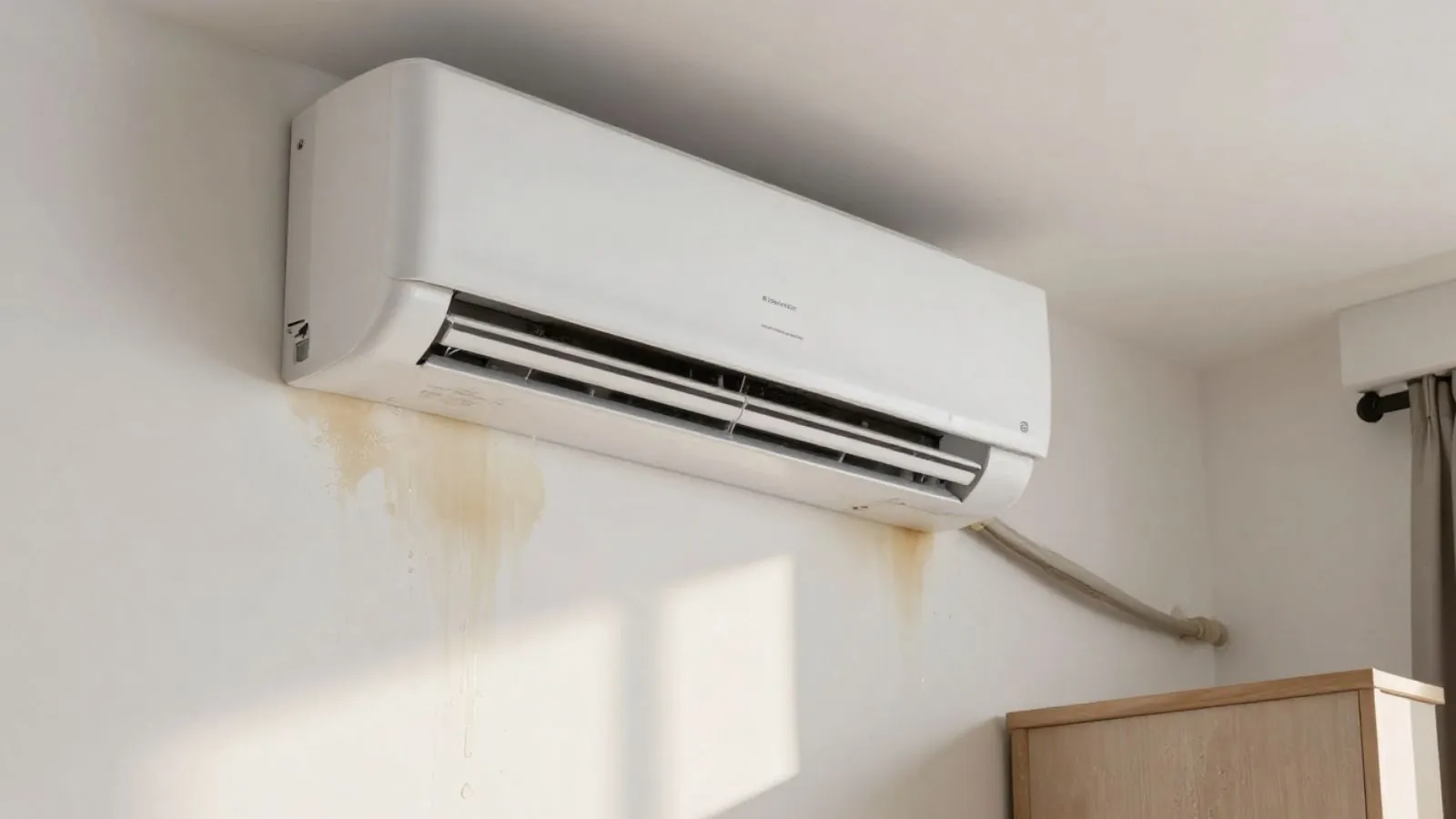
AC leak water damage is the wet ceiling, drywall, insulation and flooring left behind when an air conditioning system drains somewhere it should not. Most of it is condensate, the water a cooling coil pulls out of the air, which normally leaves through a drain line or collects in a pan under the air handler. When that path clogs, cracks or overflows, the water goes into whatever sits below the unit.
The stain usually shows up days after the leak began. A damp closet floor, a bulge in a ceiling or a musty smell near the unit are all reasons to call. Turn the system off at the thermostat so it stops making more water, and if a ceiling is sagging, keep people out from under it.
Where AC condensate water ends up
A cooling system can pull several gallons of water out of a house on a hot day. All of it has to leave through the condensate drain, and a few things commonly stop that from happening.
The point of failure decides where you see damage, which is why we ask a few questions on the phone before a crew leaves.
| Failure point | What happens | Where you notice it |
|---|---|---|
| Clogged drain line | Algae and debris block the pipe and water backs up into the pan | Overflow stain on the ceiling or floor under the unit |
| Overflowing drain pan | The pan fills, rusts through or tips and spills over the edge | Insulation and drywall around the air handler |
| Disconnected or cracked line | Water drips from the break instead of reaching the drain | A wet spot that follows the pipe route |
| Failed condensate pump | Water collects in the pump and is not sent out | Puddle near the pump, often in a basement or closet |
| Frozen coil thawing | Ice melts faster than the pan can handle | Sudden dripping when the system shuts off |
Attic units, closet units and the ceiling below
When the air handler sits in an attic, water soaks the insulation first and then drywall from above. By the time a stain appears, the framing and insulation above it have usually been wet for a while. A pull-down hatch or a closet ceiling can also show damage first because the water finds the lowest seam.
Closet and utility room units tend to soak the floor and the bottom of the walls. Water wicks up drywall and baseboard, and it slides under flooring where a surface check will not catch it. If a ceiling is the main casualty, the steps on our ceiling water damage repair page cover stains, sagging and removal in detail.
What to do while you wait for the crew
Safe steps before we arrive
- Turn the AC off at the thermostat and at the breaker for the air handler if you can reach it safely.
- Look at the drain pan only if it is within easy reach, and do not climb into an attic that has wet floor joists or no solid flooring.
- Stay away from any ceiling that bulges or drips, and do not poke it to release the water.
- Move furniture and boxes out from under the wet area and cover what cannot be moved.
- Photograph the unit, the pan and every stain before anything is cleaned. Your insurer may ask for them.
Switch the system off at the thermostat, then call the line. We find where the water traveled before anything is opened up.
How we dry an AC leak
We start with a moisture meter and a thermal camera to trace the water from the unit to the farthest damp material. Wet attic insulation is usually removed, because compressed and soaked insulation does not dry well in place. Drywall that is soft, stained and still holding moisture often comes out too.
What stays is dried with air movers and LGR dehumidifiers until readings come down to normal for each material. The process is the same one described on our structural drying and dehumidification page, scaled to a leak that is often small but hidden.
A slow AC leak and the mold question
Mold needs moisture, and a leak that drips for weeks gives it plenty. That is why we measure instead of guessing, and why an attic or wall that looks fine on the surface can still need attention.
If wet materials have sat long enough that growth is visible, mold remediation may follow the drying as a separate step that follows ANSI/IICRC S520 practice. Questions about health belong with a physician, not with a restoration company.
What affects the cost of an AC leak cleanup
The size of the stain rarely matches the size of the job. These are the factors that shape the scope, and we explain it before work starts.
| Factor | How it changes the job |
|---|---|
| How long the unit leaked | A leak that ran for weeks soaks more insulation, framing and drywall |
| Location of the unit | Attic work is slower than a closet, and overhead removal adds labor |
| Materials involved | Blown insulation, drywall and flooring each have a different drying limit |
| Area below the unit | A single ceiling is a smaller job than a ceiling, a wall and a floor |
| Repair scope | Drying is one cost. Patching, texture and paint are a separate repair decision |
Insurance may respond to sudden and accidental water damage, and it often does not cover damage from a drain line that was left to leak slowly over time. Check your policy or ask your insurer what it wants to see, and we will record readings and photos for your file.
Fixing the drain line is a different trade
We dry and restore what the water touched. Clearing a clogged line, replacing a pan or servicing the coil belongs to an HVAC technician, and we will say so honestly if that is the real cause.
This matters because a drained and dried ceiling that gets wet again next month is money spent twice. Ask your HVAC company to inspect the drain line and the pan after a leak, and keep the report with your photos.
AC leaks across Bellmore and nearby towns
The same dispatch line covers Bellmore ZIP 11710 and the nearby South Shore towns, including Freeport. Call at any hour, since an air handler that fails at night keeps making water until someone shuts it off, and same-day response is offered when available.
Frequently asked questions
Condensate from the cooling coil may be backing up and overflowing near the air handler. Turn the system off at the thermostat, avoid standing under the stain and call the line so we can trace where the water traveled.
We handle the water damage, meaning drying, removal and restoration. Clearing the drain line or replacing parts is an HVAC repair, and we will tell you when that is what the leak needs.
No, though the stains can look alike. A stain that appears only when the system runs points to condensate, while a stain that appears after rain points to the roof. We help you tell the difference on the phone.
Not always. Insulation that is lightly damp may dry in place, while soaked or matted insulation is usually removed. Moisture readings decide, not a rule of thumb.
It depends on the cause and the wording. Sudden and accidental water damage is often covered, and a long-running slow leak often is not. Check your policy or ask your insurer, and document the damage before cleanup.
As soon as you notice it. Wet drywall and insulation get worse on a daily schedule, and the line is open 24/7 with same-day response when available.
Call the line any hour and describe what you see. We will explain the scope and price before work starts.