
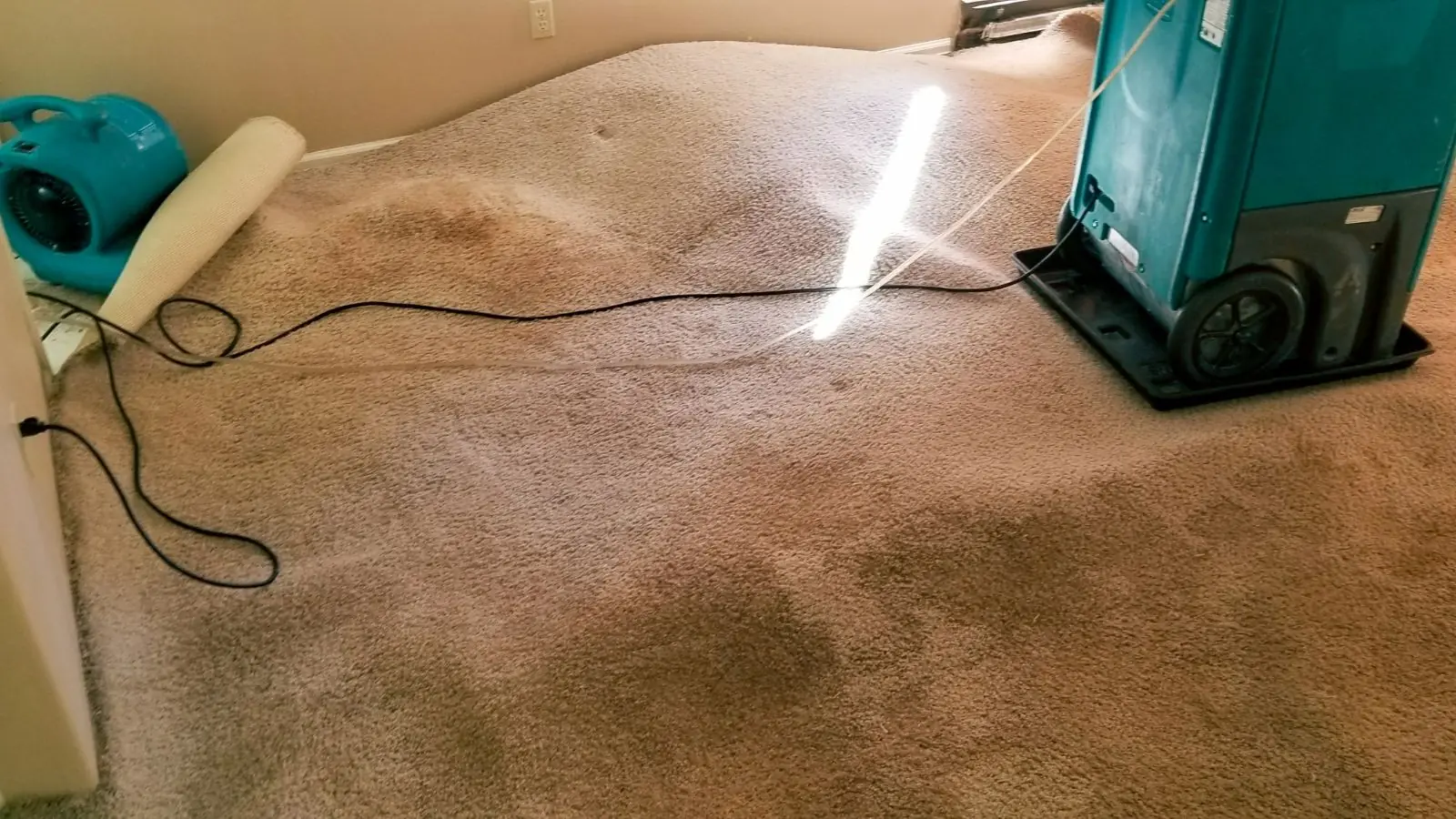
Carpet water damage is the wetting of carpet, pad and the subfloor under them. Carpet fibers dry fast, but the foam pad holds water like a sponge, and the tack strips and subfloor beneath it can stay wet long after the surface feels dry.
If your carpet is wet now, stop the source, blot standing water and call our 24/7 line. Keep people off the wet area, lift furniture onto foil or blocks and do not use a household vacuum on standing water.
Carpet, pad and subfloor: what each one holds
Carpet is a surface layer. The pad is where water goes, and the subfloor is where it can stay. A technician can lift a corner, check the pad and probe the subfloor to see how far the water spread. Without that check, a carpet that feels dry on top can hide a wet pad for days.
When the carpet pad should come out
Pad often has to go even when the carpet stays. Pad soaks up water, dries slowly and cannot be cleaned inside. If the water was clean and the wetting was caught within a day or so, pad can sometimes be dried in place. After that, or if the water was dirty, it is usually removed.
Replacing a pad is far cheaper than a mold problem under the carpet, and the carpet itself can often be cleaned, dried and put back on new pad.
Water category and age: the decision table
The source and the time wet decide the path.
| Water source and age | Usual outcome for the carpet | Usual outcome for the pad |
|---|---|---|
| Clean supply line, caught within a day | Extract, dry and keep | Dry in place if readings allow, otherwise replace |
| Clean water, wet for several days | Clean and dry, assess for odor | Replace |
| Dishwasher or washer overflow, gray water | Clean and treat, then decide | Replace |
| Sewage or floodwater | Remove and discard | Remove and discard |
Call any hour. We extract water and measure the pad before deciding what stays.
Wet carpet and mold timing
Mold needs moisture, and a damp pad under a sealed carpet is a good place for it. The practical window is the first couple of days, because drying that starts later has to work against damp materials that have been wet longer.
If wet carpet has sat for several days, mold remediation may be a separate question after drying. Testing and remediation follow ANSI/IICRC S520, a published standard, and health questions belong with a physician.
How we dry carpet in place
Extraction removes water first, often with a weighted tool that pulls from both sides. Air movers then push air under a lifted carpet corner or through a floating section, while dehumidifiers pull the moisture out of the room.
Readings are taken at each visit, and equipment stays until the carpet, pad and subfloor all read normal. The structural drying page explains the equipment and moisture mapping in more detail.
First steps when carpet is wet
Before the crew arrives
- Stop the source and remove standing water with towels or a wet vacuum made for water.
- Lift furniture off the carpet and put foil or plastic under the legs.
- Remove rugs and loose items, and hang wet items to dry.
- Open windows only if the weather allows, and run air conditioning to keep humidity down.
- Photograph the wet area and any stains before cleanup.
Stairs, closets and tack strips
Carpet on stairs and in closets is easy to overlook. Water runs to the lowest point, so a closet floor next to a wet room can hold more than the room itself.
Tack strips are wooden and absorb water along the edges of a room. They are checked and replaced if they stay wet, because a damp strip can wick moisture into new carpet.
What affects the cost of carpet water damage
We explain scope and price before work starts, and these factors decide the number.
| Factor | How it changes the job |
|---|---|
| Water category | Clean water allows more to be saved, while contaminated water means removal |
| Time the carpet stayed wet | Longer wetting reduces the chance of saving the pad and carpet |
| Carpet and pad type | Wool, synthetic and glued-down carpet each dry differently |
| Area involved | More rooms mean more extraction and drying equipment |
| Subfloor condition | Wet plywood or concrete has to dry before new pad goes in |
Insurance often covers sudden and accidental water damage, and gradual leaks are often treated differently. Flood damage usually needs separate flood coverage. Check your policy or ask your insurer, and ask what documentation they want. We record moisture readings and photos so you have them ready.
Carpet after Bellmore storms and flooding
Local press reported several feet of water in parts of South Bellmore during Hurricane Sandy in 2012. Carpet that sat in water from a surge like that is almost always removed, because the water is contaminated and the pad cannot be cleaned. If your carpet is wet from a leak, hardwood nearby may be affected too, which is covered under hardwood floor water damage.
We serve ZIP 11710 and nearby areas including Freeport, and the line is open 24/7.
Frequently asked questions
Often, if the water was clean and drying started quickly. The pad is more likely to need replacement than the carpet.
Not always. Corners can be lifted so air moves under the carpet. Pad is removed when it cannot be dried or when the water was contaminated.
It depends on the materials and the conditions. Mold needs moisture, so drying quickly is the best prevention, and a damp pad under sealed carpet is a risk.
Sudden and accidental damage is often covered, gradual leaks often are not, and flood usually needs a separate policy. Check your policy or ask your insurer.
A household cleaner removes some surface water but cannot dry the pad or the subfloor. A measured drying job is different from a cleaning.
Yes. The dispatch line answers 24 hours a day, and same-day response is offered when available.
Call the line any hour and describe what you see. We will explain the scope and price before work starts.